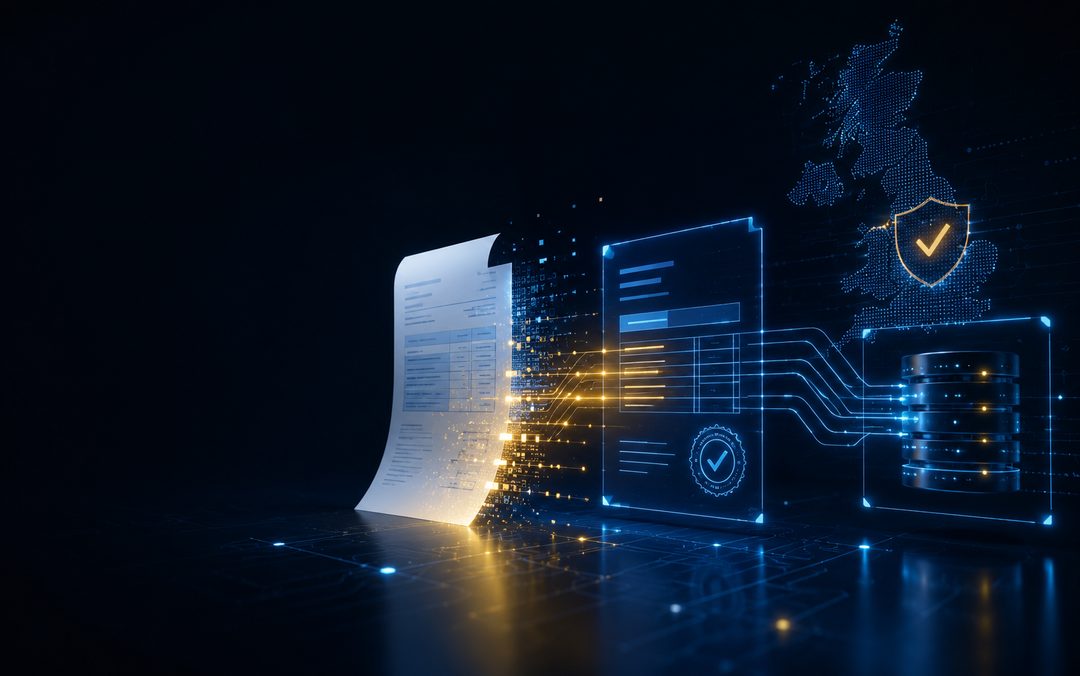
E-invoicing is coming to the UK, and it is bigger than swapping paper for email. At the Autumn Budget 2025 the government confirmed that structured e-invoicing will become mandatory for all VAT invoices, for both business-to-business and business-to-government transactions, from April 2029. That may sound comfortably far away, but the systems and process changes involved take real time, and the businesses that start now will find it painless. Here is what the mandate actually is, when it lands, and the practical steps to get your documents ready.
What is e-invoicing, really?
An e-invoice is not a PDF. This is the single most important thing to understand. E-invoicing means exchanging invoice data in a structured, machine-readable format that passes directly from one finance system to another and is processed automatically, with no one re-keying anything. A PDF, a Word file, a scanned paper invoice or a photo is a picture of an invoice: a human or another program still has to read it and type the numbers in. Under the mandate, those will no longer count. A real e-invoice is data, not a document you look at.
When does it happen? The timeline
The UK is moving deliberately, and it is not alone, so it helps to see the whole picture.
| When | What happens |
|---|---|
| Jan 2026 | HMRC and the Department for Business and Trade begin working with industry on the UK approach. In the EU, Belgium prohibits PDF B2B invoices. |
| Budget 2026 | The UK government is due to publish its e-invoicing implementation roadmap and standards. |
| Sept 2026 | France begins its own e-invoicing rollout. |
| 2027 to 2028 | Detailed UK guidance emerges; businesses and software providers prepare systems and data. |
| April 2029 | Mandatory e-invoicing for all UK VAT invoices (B2B and B2G) is set to begin. |
| By 2030 | The EU's VAT in the Digital Age (ViDA) reforms mandate structured e-invoicing for intra-EU B2B trade, with near real-time reporting. |
Why is this happening?
Two reasons, mostly. First, tax: structured, automatically reported invoices make VAT far harder to get wrong or to dodge, which is why governments across Europe are moving the same way. Second, efficiency: manual invoice handling, the printing, scanning, keying and chasing, is slow, error-prone and expensive. E-invoicing removes it. Increasingly, AI sits alongside this, handling capture, matching and exception-routing automatically, so the whole invoice-to-payment process runs with very little manual touch.
What should you do now?
You do not need to solve 2029 today, but you do need to start. The practical first steps are straightforward:
- Audit your invoice flow. Map how invoices are generated, sent, received and archived, and mark every step that involves printing, scanning, manual entry or emailing PDFs. Those are the steps that will have to change.
- Clean your master data. Structured invoicing only works if your supplier and customer records are accurate and consistent. Fixing this now removes a lot of future pain.
- Plan for structured formats. Understand how your accounting and finance systems will send and receive structured invoices, and where the gaps are.
- Sort out capture, storage and retention. You will still need to store invoices and prove you did, so make sure your document and records system can capture them, keep them securely, and retain them for the required period with a full audit trail. Our guide on how long to keep business records covers the periods involved.
Where DocFlow fits
DocFlow is not your accounting package, and it does not replace it. What it does is handle the document and records side of invoicing, which is exactly the part most businesses have not thought about. As invoices arrive, in whatever form during the transition, Aida can capture and classify them and extract the key data automatically, so you are already working with structured information rather than PDFs in an inbox. Everything is stored securely with workflow automation for approvals, retention applied automatically, and a tamper-evident audit trail behind every record. When the mandate lands, your invoice records are already organised, searchable and audit-ready. If you are already moving away from paper, our guide on document digitisation is a good next read.
If you want the practical detail on the invoice side of that, our guide to accounts payable automation in the UK covers capture, matching, approval routing and the audit trail.
E-invoicing is one of those changes that looks like a finance problem and turns out to be a documents-and-data problem. Start with the audit, get your records in order, and April 2029 becomes a deadline you are ready for rather than one that catches you out.