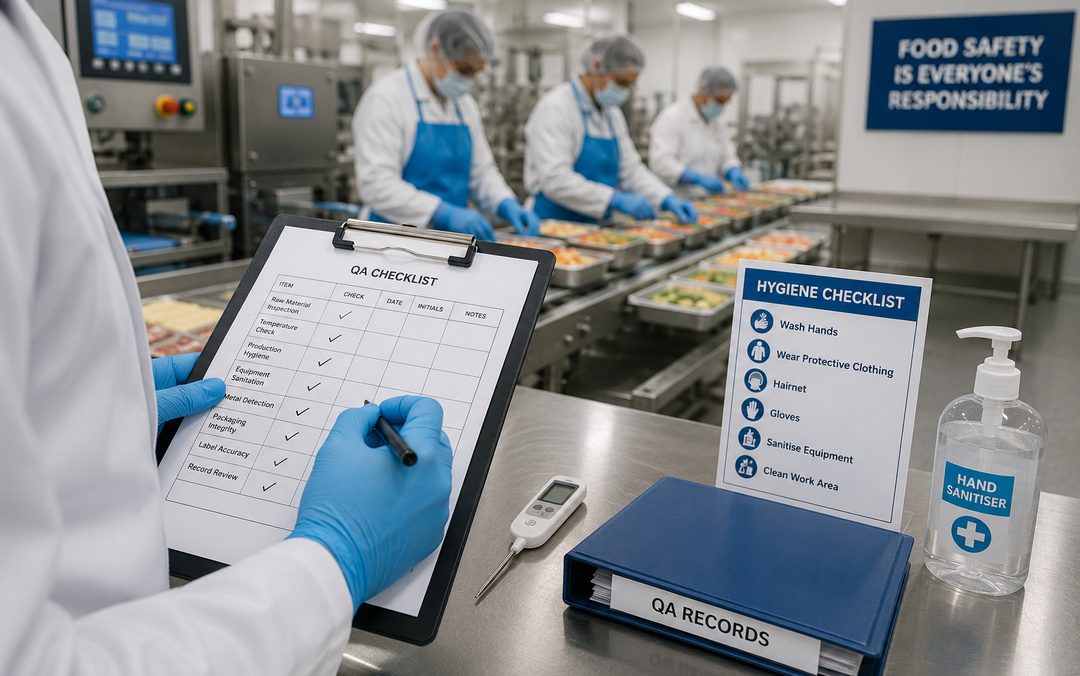
Every food manufacturer knows the week before a BRCGS audit. Someone is in the office until eight at night pulling temperature logs out of ring binders, someone else is chasing a supplier approval certificate that expired in March, and there is always one traceability record that nobody can put a hand on. The standard itself is rarely the problem. Finding the evidence is.
With Issue 10 of the BRCGS Food Safety Standard now working its way through publication, this is a sensible moment to fix that properly. Here is where the revision stands, what auditors actually look for, and the records work that pays off whatever the final standard says.
Where Issue 10 has got to
Public consultation on Issue 10 closed in February 2026. BRCGS will publish the final standard, and a transition period will follow before audits switch across to it. Until that transition ends, Issue 9 remains the standard you are audited against - it was released in August 2022 and has been mandatory for all audits since 1 February 2023.
A word of caution here, because it matters. Until BRCGS publishes the final text, nobody outside the process knows exactly what Issue 10 requires. The commentary in circulation points towards greater emphasis on digitalisation, the use of AI, improved audit transparency and food safety culture, but that is direction of travel, not clause detail. Do not rebuild your systems around speculation. Build them around evidence you can retrieve, because that requirement is not going anywhere.
What a BRCGS auditor is actually doing
It is worth being clear about the job in front of the auditor, because it explains why so many non-conformances are really filing problems.
The auditor verifies two separate things. First, that the documentation exists and is current - the policies, the HACCP plan, the procedures, the records. Second, and this is the part that catches sites out, that what is documented is actually being done. A beautiful procedure with no completed records behind it is worse than useless; it is evidence of a system that is not being followed.
So when you cannot produce a record on request, the auditor is not just noting a missing piece of paper. They are being invited to conclude that the control might not have happened at all.
The records you need to be able to produce
The specific list depends on your site and your scope, but the documents an auditor will routinely ask for look like this:
| Record | What it has to show |
|---|---|
| HACCP plan | Current, reviewed, with the hazard analysis and critical control points documented and justified. |
| Food safety policy | Signed, current, and communicated to staff. |
| Procedures and specifications | Version-controlled, with the current version in use on the floor - not an old print-out in a folder. |
| Supplier approval | Approval decisions, certificates and their expiry dates, plus ongoing performance monitoring. |
| Corrective actions | What went wrong, what was done, who signed it off and whether it worked. |
| Internal audits | A planned programme, actually completed to schedule, with findings closed out. |
| Traceability | A documented procedure and the ability to demonstrate it under test, both directions, within the time limit. |
| Training | Who was trained, on what, when, and evidence of competence. |
| Monitoring records | The daily reality - temperature logs, checks, calibration records - complete, legible and signed. |
Retention: longer than most sites assume
BRCGS does not hand you a single retention figure, which is precisely why sites get it wrong. Records must be kept for a period appropriate to the shelf life of the product, plus whatever your customers contractually require on top. A long-life ambient product carries a materially longer retention period than a short shelf-life chilled line, and a major retailer customer will often impose its own minimum that exceeds both.
The requirement that trips people up is the next one: records must be stored securely and protected against loss, damage or unauthorised modification. Think about what that means for a pencil-completed temperature log in a folder in a damp corner of the despatch bay. Or for a spreadsheet on a shared drive that anyone can overwrite with no history. Neither can demonstrate it has not been altered.
If you want the wider picture on retention across the business, our guide to how long to keep business records in the UK covers the statutory periods that sit alongside your BRCGS obligations.
Why paper fails the audit, not the site
Most food manufacturers we speak to are not running a bad system. They are running a good system on bad infrastructure. The controls happen, the checks get done, the records get completed - and then they go into a binder where they are effectively invisible until someone spends three hours looking.
That gap produces a specific, avoidable category of non-conformance: the record existed, the control happened, and the site still lost marks because the evidence could not be produced in the room. It is a filing failure being scored as a food safety failure.
What to do now, ahead of Issue 10
- Find your slowest record. Pick the document an auditor asked for last time that took longest to produce. That is your weakest point, and it will be asked for again.
- Define retention properly. Write down the retention period for each record type, derived from shelf life plus customer requirements, and make sure it is applied consistently rather than remembered.
- Close the version-control gap. Make sure the procedure in use on the floor is provably the current one, and that superseded versions cannot be picked up by mistake.
- Get a real audit trail. You need to be able to show who created or changed a record and when. This is the requirement paper and shared drives simply cannot satisfy.
- Run a mock retrieval. Ask a colleague to request five records at random and time it. That number is what your audit will feel like.
Where DocFlow fits
DocFlow does not replace your quality management system or your HACCP plan. What it does is hold the evidence behind them in a form an auditor can be walked through in seconds rather than hours.
Records are captured as they are produced - Aida can classify and index incoming documents such as supplier certificates automatically, so they are filed correctly without anyone deciding where they go. Retention rules are applied automatically against each record type. Workflow automation routes corrective actions and approvals so they are signed off and evidenced rather than chased. Every record carries a tamper-evident audit trail showing who touched it and when, which is exactly the protection against unauthorised modification the standard asks for. And when the auditor asks for the calibration certificate for a specific probe on a specific date, you search for it in front of them.
We work with food manufacturers on precisely this problem - see our food manufacturing document management page for how it fits a production environment, or our guide to document digitisation if you are still getting historical records out of paper.
Issue 10 will land when it lands. The sites that will find it straightforward are the ones that stopped storing their evidence in binders well before it did.