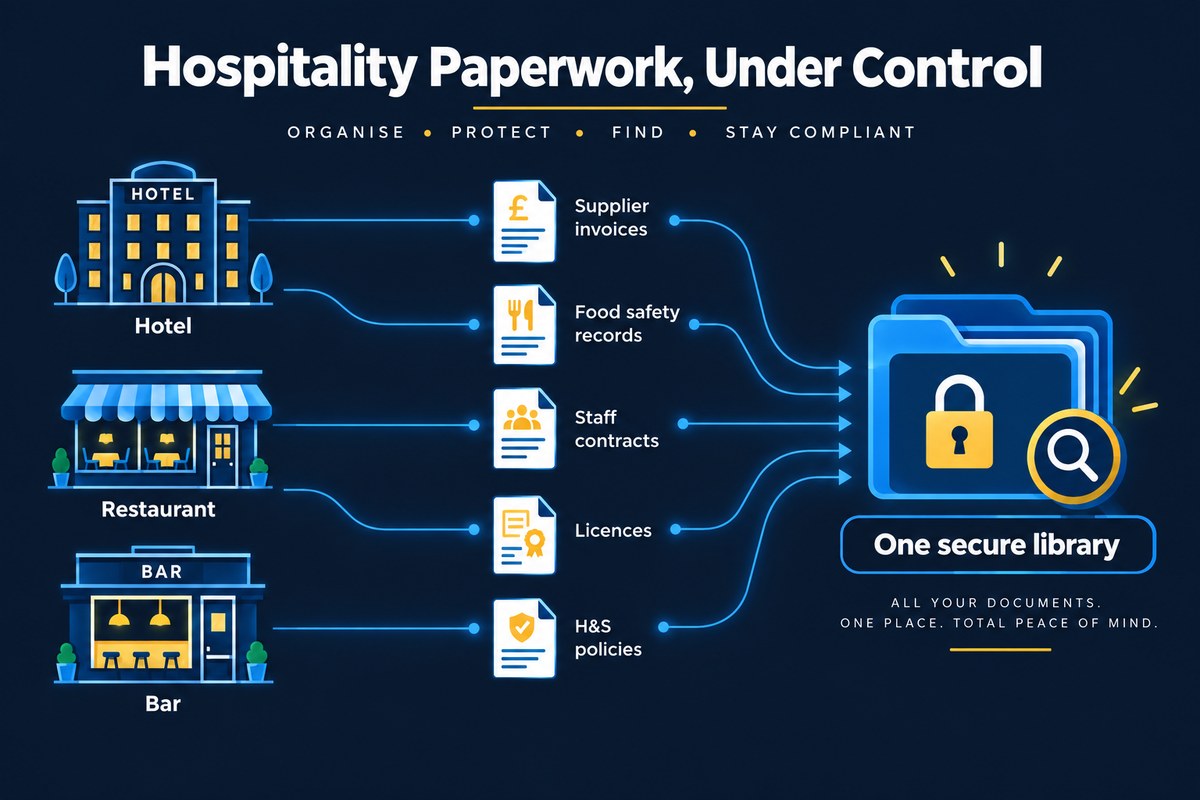
Hospitality document management means keeping every venue's supplier invoices, licences, food safety records, health and safety policies and staff files in one secure, searchable system. Each site controls its own documents, head office sees everything, and retention and audit trails are applied automatically, so any record can be produced in seconds when an inspector calls.
Behind every hotel, restaurant and bar sits a mountain of paperwork. Supplier invoices arrive daily, food safety checks are logged on every shift, licences need renewing, policies need signing, and every new starter brings a contract and a right to work check. For a group running several sites, with shift-based teams and high staff turnover, keeping it all organised and inspection-ready is a genuine operational challenge. This guide covers the records you need to keep, how long to keep them, and how a document management system keeps every site audit-ready without adding admin.
Key takeaways
- Hospitality runs on records: invoices, licences, food safety logs, H&S policies, guest registers and staff files.
- Multi-site groups struggle most, because records are created everywhere by shift-based teams.
- In England, every business must keep a written fire risk assessment, whatever its size.
- Retention periods range from 12 months for hotel guest registers to six years for financial records.
- A central, access-controlled library with automatic capture, sign-off tracking and retention keeps every venue ready.
What documents does a hospitality business need to keep?
The records a hospitality business holds fall into a handful of groups, and each matters for a different reason:
| Record type | Examples | Why it matters |
|---|---|---|
| Finance | Supplier invoices, delivery notes, purchase orders, VAT records | Cost control, payment accuracy and HMRC requirements |
| Licensing | Premises licence, personal licences, music and entertainment licences | Trading legally; the premises licence must be kept on site |
| Food safety | Food safety management and HACCP records, temperature logs, cleaning schedules, supplier traceability, allergen information | Hygiene inspections, traceability and protecting customers |
| Health & safety | Written fire risk assessment, H&S policies, accident records, gas and electrical certificates | Legal duties to staff and guests |
| Guests | Hotel guest register (guests aged 16 and over) | A legal requirement for hotels and other accommodation |
| People | Contracts, right to work checks, training records, rotas | Employment law and immigration compliance |
| Contracts | Leases, supplier agreements, service contracts, event bookings | Knowing obligations, renewals and notice dates |
Why is hospitality paperwork so hard to manage?
Hospitality has a set of challenges that most office-based businesses do not:
- Records are created everywhere. Each venue produces its own invoices, logs and staff files, often on paper in a back office.
- Teams work in shifts and change often. High staff turnover means knowledge of where things are kept walks out of the door with every leaver.
- Head office has limited visibility. Checking whether every site has a current fire risk assessment or signed policy usually means phoning round.
- Inspections arrive with little warning. Environmental health, licensing and fire safety officers expect records to be available on the day.
- Supplier invoices pile up. Dozens of deliveries a week create a steady flow of invoices that need checking, approving and filing.
What do inspectors and auditors ask to see?
When an officer or auditor visits, the requests are usually predictable:
- Food safety. Food businesses must have food safety procedures based on HACCP principles, and inspectors will want to see that they are followed and recorded. You also need to be able to trace food one step back to your supplier and, where you supply other businesses, one step forward.
- Licensing. Licensed premises must keep the premises licence, or a certified copy, on site, with a summary on display.
- Fire safety. In England, every business must keep a written record of its fire risk assessment and fire safety arrangements, regardless of how many people it employs.
- Staff. Employers must be able to show a right to work check for every member of staff.
- Guests. Hotels and other accommodation must keep a register of guests aged 16 and over, available to the police on request.
None of this is difficult to hold. What is difficult is finding the current version quickly, for the right venue, and proving it was in place at the time.
How long should hospitality businesses keep records?
Different records must be kept for different lengths of time. These are common UK periods, but always confirm what applies to your business:
| Record | Typical retention |
|---|---|
| Financial and VAT records | Generally six years |
| Payroll records | At least three years after the end of the tax year |
| Right to work check copies | Length of employment plus two years |
| Accident records | At least three years from the date of the entry |
| Hotel guest register | At least 12 months |
| Licences and fire risk assessments | Keep the current version available, and archive superseded versions |
For the wider picture, see our guide on how long to keep business records in the UK.
How does a document management system help multi-site groups?
A document management system replaces filing cabinets, scattered shared folders and email attachments with one controlled library. For hospitality, the practical differences are:
- One library, a workspace per venue. Each site sees its own documents, while head office sees everything and can check compliance across the group.
- Invoices captured automatically. Supplier invoices and contracts are classified as they arrive, with dates, amounts and parties extracted, ready for approval. Our guide to accounts payable automation explains how that works.
- Policy sign-off you can prove. Reading confirmations show exactly which staff have read each H&S policy or procedure, and when.
- Retention applied for you. Each record type is kept for the right period and flagged for review, rather than kept forever or lost.
- Found in seconds, from anywhere. Full-text search finds any licence, certificate or invoice, even scanned ones, from a web browser, scoped to the sites a user can access.
- A complete audit trail. Every upload, approval, change and view is logged, which is exactly what an auditor wants to see.
How to get started
You do not need to digitise years of paper overnight. A sensible order is to start with the records that cause the most pain, usually supplier invoices and compliance documents, set up a consistent structure for every venue, then bring staff files and contracts across. Archive paper can be scanned in batches over time. Our guide on how to go paperless walks through the approach in more detail.
Where DocFlow fits
DocFlow is built for exactly this kind of multi-site document work. Each venue gets its own workspace with team-based access and per-site retention, while head office keeps the full picture. Aida, DocFlow's AI engine, classifies and extracts supplier invoices, contracts and purchase orders as they arrive, and reading confirmations track sign-off on every policy. Everything sits behind five-tier role-based access with a complete audit trail, and DocFlow runs in the cloud, UK-hosted, or on-premise. Mastercopy is certified to ISO 27001 and ISO 9001. See how it works for the sector on our hospitality page.