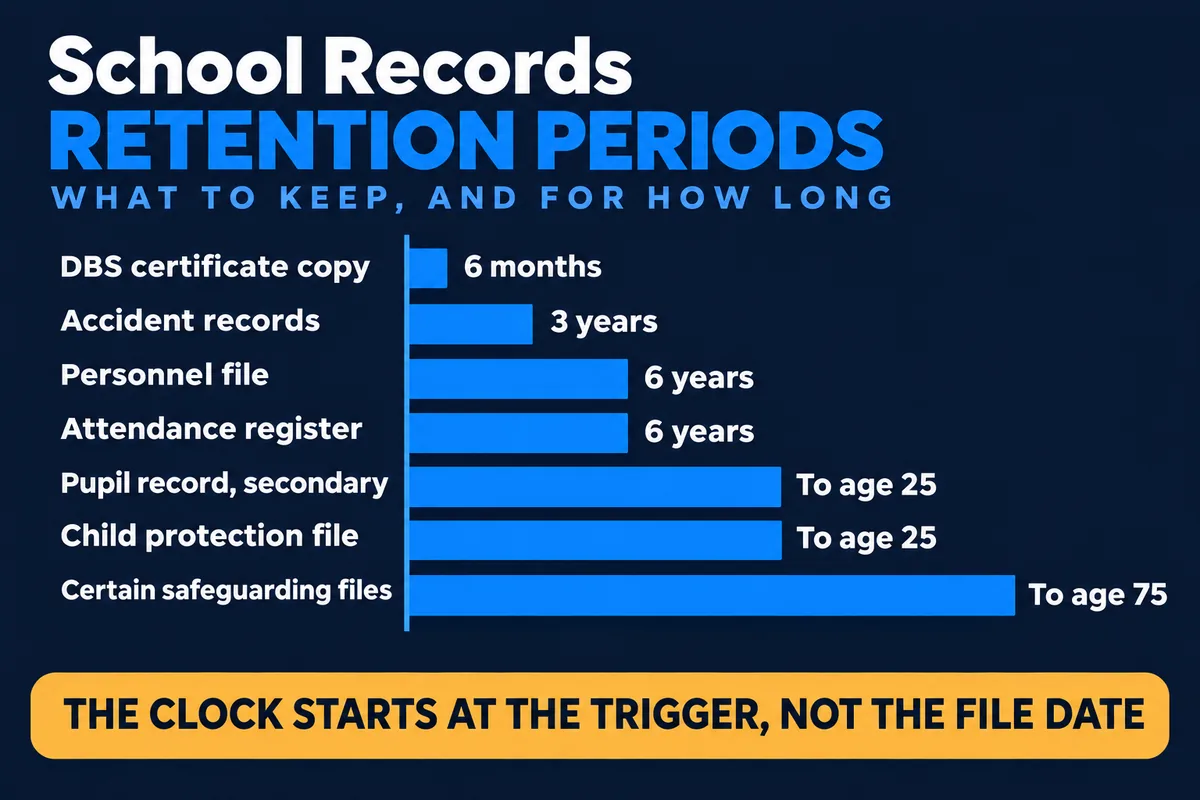
Schools and academies in England hold some records until a pupil is 25, some until they would be 75, and some for only six months. The periods are published by the Department for Education, several are described as statutory, and the two most commonly missing from an inherited schedule are the longest ones of all.
Retention is the part of school record keeping that gets written into a policy and then never applied. It is rarely deliberate. A schedule is adopted from a template, the template ages, people change roles, and the cupboard or the shared drive quietly becomes the policy. The risk runs in both directions: destroy a safeguarding record too early and it cannot be produced when it is needed most, keep everything forever and you are holding personal data you have no basis for.
Is there a statutory retention schedule for schools?
Partly, and the distinction is worth being precise about because it shapes how much discretion a school actually has.
The Department for Education publishes retention periods for school records in its data protection in schools guidance, and describes a defined set of them as having statutory retention periods. Those tables cover pupil records, safeguarding files, staff and recruitment records, admissions, attendance, finance, premises and governance. For records outside them, the DfE position is that a school should decide how long it needs to keep the record in line with the business need of the school.
So the schedule is half given and half delegated. The delegated half still has to be written down, applied and defensible, because the storage limitation principle in UK data protection law does not accept an absence of decision as a reason for holding personal data.
One practical note, because it causes confusion. For years the sector worked from the Information and Records Management Society toolkit for schools, and a great many retention policies still in use are derived from its 2012 edition. The IRMS material is now behind membership rather than freely downloadable, which means a school checking its schedule against the source may find it cannot reach the source. The DfE guidance is free, current and sufficient for the statutory periods, and is the better reference point for that reason.
How long must schools keep each type of record?
A summary of the periods asked about most often. This is an orientation rather than the schedule itself, and the DfE tables carry conditions that matter in individual cases.
| Record | Retention period |
|---|---|
| Pupil record, primary | Until the pupil leaves; management information system data for two terms after |
| Pupil record, secondary | Until the pupil turns 25 |
| Child protection file | Until the child turns 25, and longer in certain cases |
| Allegation against a member of staff | Normal retirement age, or 10 years from the allegation, whichever is later |
| Copy of a DBS certificate | 6 months from the date of recruitment |
| Personnel file | 6 years from the end of employment |
| Pay records | 3 years from the end of the related tax year |
| Admissions | 6 years from the date of admission |
| Attendance register | 6 years from the date of entry |
| Accident records | 3 years |
| Educational visit records | 10 years |
| Annual governors' reports | 10 years |
| Health surveillance records | 40 years |
| Title deeds | 12 years |
The two periods schools most often get wrong
If you check nothing else against your own schedule, check these.
Some child protection files run to age 75 rather than age 25. The longer period applies where the file concerns child sexual abuse, and it is a fifty year difference sitting inside a single line of a retention table. A schedule carrying only the age 25 rule will dispose of exactly the records whose absence causes the most harm. Child protection files also travel: where a pupil moves school the file goes with them, so a school can be the custodian of a file for a child it has never taught.
Records of allegations against staff run to normal retirement age or ten years from the allegation, whichever is later. This applies to allegations that were found to be unfounded as well as those that were substantiated. People reasonably object to that at first hearing, and the reason is sound: the record exists to show the allegation was handled properly, and to make a pattern visible if a similar concern arises years later. Because it outlives the six year personnel file by decades, it must not be filed as part of the personnel file and disposed of with it.
When does the clock actually start?
On the trigger the schedule names, and that is almost never the date the document was created.
A secondary pupil record runs to the pupil's 25th birthday. An admission record runs six years from the date of admission. An attendance register runs six years from the date of entry. A personnel file runs six years from the end of employment. Four different records, four different clocks, and only one of them has anything to do with when the file was made.
This is where retention most often fails in practice. A school that applies a single period from a creation date to everything will simultaneously delete things too early and hold others far longer than it should, and both are findings. A system that records the triggering event, rather than only the upload date, removes the arithmetic from the people doing the filing.
What about DBS certificates and the single central record?
The single central record is a statutory requirement under Keeping Children Safe in Education, and it is a record that checks were carried out and when. It is not a filing cabinet for the certificates themselves.
Schools are not required to keep a copy of a DBS certificate to satisfy the single central record. Where a copy is taken there needs to be a reason for taking it, and the DfE sets retention at six months from the date of recruitment, after which it is securely destroyed. The DBS guidance for employers makes the same point for employers generally: certificate information is destroyed once it is no longer needed.
The cleanest position, and the one that removes an entire category of risk, is to record the certificate number and the date on the single central record and keep no copy at all. A folder of scanned DBS certificates from the past decade is one of the more common findings in a school information audit, and there is usually nothing requiring it to exist.
What KCSIE 2026 expects you to be able to evidence
Keeping Children Safe in Education 2026 came into force on 1 September 2026 and remains the current edition, amended as recently as 17 November 2026. Alongside the safer recruitment changes, it carries expanded expectations on record keeping and information sharing, including keeping evidence of the filtering and monitoring checks a school carries out: when they were run, what was tested, what was found and what was done about it.
The direction of travel across all of it is the same. The expectation is not that a school has a policy saying what it does. It is that a school can show what it actually did, on the day someone asks. Those are different capabilities, and only one of them can be met by a document.
What this looks like in practice
Three questions settle whether retention is real in a school or only written down.
- Can you list what you hold? Not the categories, the records. A school that cannot produce the list cannot apply a schedule to it.
- Does each record carry its own period, from its own trigger date? A single blanket period applied to everything guarantees two kinds of error at once.
- Can you show a disposal happened, when, and on whose authority? Destroying a record and being able to evidence that you destroyed it properly are not the same thing, and only the second one helps you.
Subject access requests make this concrete faster than any inspection. A parent asking for everything the school holds about their child starts a one month clock, and the work is proportional to how scattered the records are. Where a school can search one controlled place, it is an afternoon. Where it means a shared drive, three email accounts, a cupboard and a former colleague's memory, it is the reason the deadline gets missed.
Where DocFlow fits
DocFlow applies a retention period to a record automatically from the date the schedule actually names, rather than from the date somebody uploaded it, and records every access, amendment and disposal in an audit trail that cannot be edited afterwards. Where a pupil record has to be produced, or a subject access request has to be answered, the search is one place rather than several.
It is built and supported in the UK by Mastercopy, and has been used in regulated environments where producing the record matters more than storing it. If your retention schedule currently lives in a policy document rather than in your systems, that is the gap worth closing first.
Schools are not the only organisations with a fixed period attached to a duty of this kind. Care providers carry a parallel duty on record quality under CQC Regulation 17, which is a separate test from how long a record is kept, and every organisation has a baseline set of periods covered in our guide to how long to keep business records in the UK. Where requests and complaints about personal data are concerned, the new data complaints process changes what an organisation has to be able to show.