Key takeaways
- Awaab's Law Phase 2 comes into force on 30 November 2026 and extends the existing duties to seven further hazard categories.
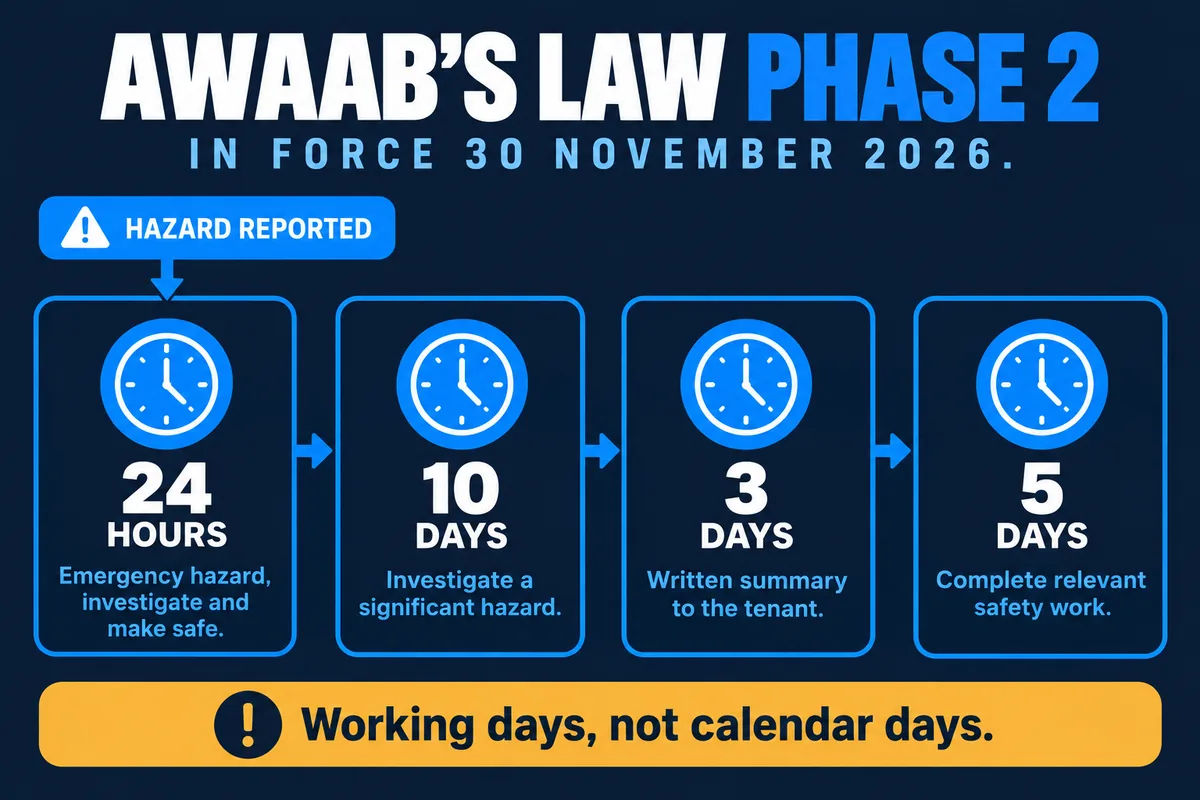
- The statutory clocks are 10 working days to investigate, 3 working days for the written summary to the tenant, and 5 working days for safety work, with 24 hours for emergencies.
- They are working days, not calendar days, and several widely published summaries still quote the consultation figures of 14 days and 48 hours.
- The clock starts when a landlord is made aware, which includes a third party report or something noticed on a routine visit, not only a formal complaint.
- Enforcement turns on being able to show all reasonable steps were taken, including failed access attempts and contractor communications.
- A repair that happened but cannot be evidenced is, for these purposes, close to a repair that did not happen.
Awaab's Law does not primarily ask social landlords to repair faster. It asks them to prove, on a date someone else chooses, exactly when they were told about a hazard, what they did, and when. That is a records problem wearing a repairs problem's clothes, and Phase 2 widens it considerably from 30 November 2026.
The law is named after Awaab Ishak, who died in 2020 at the age of two from a respiratory condition caused by prolonged exposure to mould in his home. The duties it creates are specific, they carry fixed clocks, and the evidence that they were met has to exist somewhere a regulator can see it.
What changes on 30 November 2026?
Awaab's Law is being introduced in phases, with a test and learn period between each one.
| Phase | In force | Hazards covered |
|---|---|---|
| Phase 1 | 27 October 2025 | All emergency hazards, and significant damp and mould |
| Phase 2 | 30 November 2026 | Adds excess cold, excess heat, falls on the level, structural collapse, fire and explosions, electrical hazards, domestic hygiene |
| Phase 3 | To be confirmed | The remaining HHSRS hazards, excluding overcrowding |
The duties themselves do not change in Phase 2. The range of things that trigger them does, and it roughly doubles. A landlord that has built its process around damp and mould reports now has to apply the same clocks to a cold flat, a loose handrail, a faulty consumer unit and a blocked waste pipe.
What are the statutory timescales?
These come from the government guidance on timeframes for repairs.
| Step | Significant hazard | Emergency hazard |
|---|---|---|
| Investigate | Within 10 working days of being made aware | Within 24 hours |
| Written summary to tenant | Within 3 working days of the investigation concluding | Within 3 working days |
| Relevant safety work | Within 5 working days of the investigation ending | Within 24 hours |
| Supplementary preventative work | As soon as reasonably practicable, 12 week backstop | As soon as reasonably practicable |
Working days, not calendar days
This is worth pausing on. A considerable amount of published material, including guidance pages on council websites, still quotes 14 calendar days to investigate and 48 hours for the written summary. Those are the figures from the consultation stage. The regulations landed on 10 working days and 3 working days.
Over an ordinary fortnight the two counts are close enough that nobody notices. Over Christmas, Easter or a run of bank holidays they separate by several days, and a team working to a calendar day count will believe it is compliant while the statutory clock says otherwise. Any system that calculates these dates needs a working day calendar behind it, not an arithmetic one.
When does the clock actually start?
This is the question that decides most disputes, and it is more generous to the tenant than people expect. A landlord is made aware of a potential hazard when it is told by the tenant, when it is notified by a third party, or when the issue is discovered during a routine inspection or visit.
So the clock can start without anyone making a complaint at all. A gas engineer attending an annual service who notes black mould in a bedroom has started it. A neighbourhood officer who sees a cracked panel on a walkway has started it. A social worker who phones the housing team has started it.
In most organisations those three routes land in three completely different places: a job note in the contractor's system, a line in a visit report, a voicemail. If the only durable record of a hazard being reported is in a contractor's own system or an officer's notebook, the organisation cannot evidence when it was made aware, which means it cannot evidence that it met the deadline even when it did.
What has to be recorded?
The guidance expects landlords to keep accurate and up to date information about residents and their homes, together with clear records of all engagement, investigations and communications with tenants. For enforcement, the test is whether the landlord can show it took all reasonable steps to comply.
That phrase does most of the work. It means the defensible file is not just the repair record. It is:
- The report itself, with the date and route it arrived by, whether that was the tenant, a third party or an officer's observation.
- The investigation, including who attended, when, what was found and the evidence behind the finding, which increasingly means photographs and survey readings.
- The written summary sent to the tenant, and the date it was sent, not the date it was drafted.
- Access attempts, including the ones that failed. A tenant who is not in when the contractor calls is a defence, but only if the attempt was logged at the time.
- Contractor communications, because availability is part of what reasonable steps means.
- The works, with start and completion dates against the statutory windows.
None of that is exotic. What makes it hard is that those six things are usually produced by five different systems and three different organisations, and the only place they come together is in somebody's email.
Why this is a document problem rather than a repairs problem
Most social landlords are not failing to do repairs. They are failing to be able to show, quickly and in one place, the sequence of events for a specific property on a specific date eighteen months ago.
The housing management system holds the case. The contractor's system holds the job. The surveyor's photographs are on a phone or in a cloud folder. The written summary to the tenant is in Outlook. The access attempt that failed is a line in a log that may or may not still exist. When the Housing Ombudsman or the Regulator of Social Housing asks what happened, assembling that story is a research project, and the gaps in it are indistinguishable from non-compliance.
The same shape of problem turns up wherever a statutory clock meets a paper trail. We have written about it in the context of NHS records retention and BRCGS Issue 10 food safety records, and the lesson repeats: the organisation is usually compliant and usually cannot prove it.
What good looks like before 30 November
- One front door for hazard reports. Tenant calls, third party notifications and officer observations all have to land somewhere that date stamps them, or the clock start is unprovable.
- Working day calculation, not calendar. Deadlines computed against a bank holiday calendar, surfaced before they are missed rather than reported after.
- Evidence attached to the case, not to a person. Photographs, surveys, the written summary and contractor correspondence filed against the property and the case automatically.
- Failed access attempts logged as events. They are part of the reasonable steps defence and they are the thing most often missing.
- An audit trail nobody can edit afterwards. A timeline that can be amended later is not evidence, whatever it says.
DocFlow is a document management platform rather than a housing management system, and it is not a replacement for one. What it does is hold the evidence layer underneath: capture from any source, filing against the property and the case, retention applied automatically, and an audit trail of every access, amendment and disposal that cannot be altered after the fact. Where the question is what can you prove and when did you know, that layer is the answer.
DocFlow is built and supported in the UK by Mastercopy, and has been serving organisations in regulated environments since 1989. If your answer to "when were we first told about this" currently involves searching three systems and an inbox, that is the gap worth closing before November.
Sources: the phase dates and hazard categories follow the government's Awaab's Law collection and the Phase 2 guidance for social housing landlords. The statutory timescales, the definition of being made aware and the reasonable steps test are taken from the guidance on timeframes for repairs in the social rented sector. Last reviewed 2 October 2026.