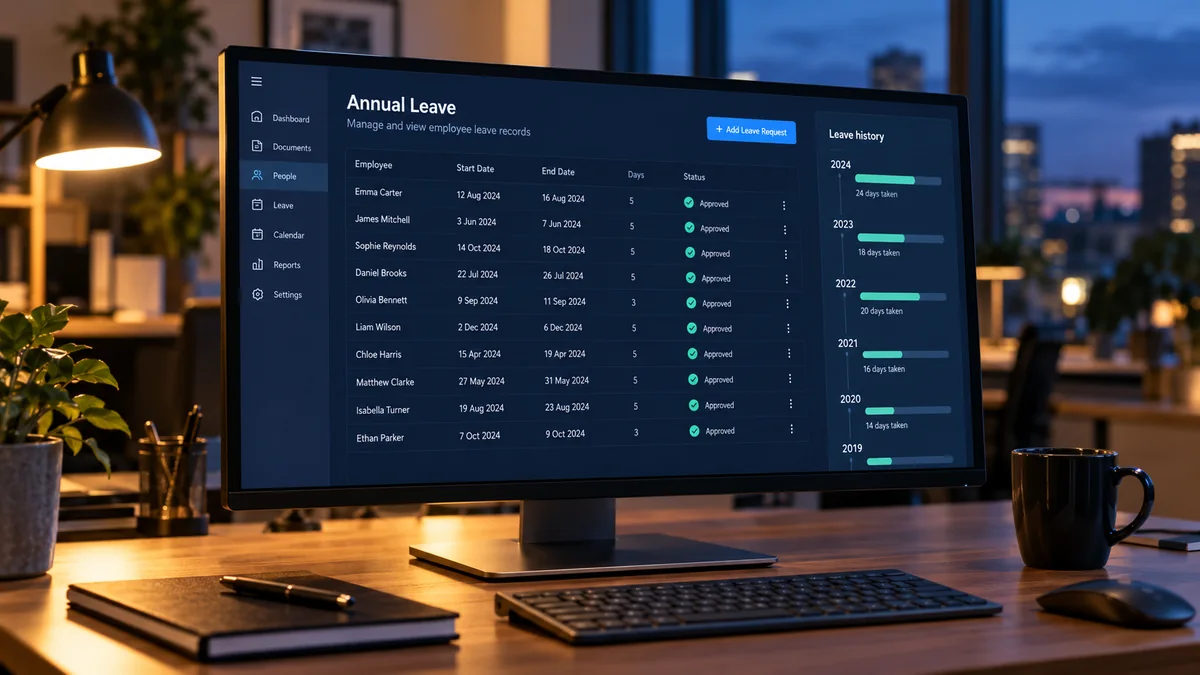
Since 6 April 2026, UK employers must keep records of annual leave and holiday pay, and must keep them for at least six years. It came in under the Employment Rights Act 2025, it applies to employers of every size, and it arrived alongside enough other changes that a good many organisations have not noticed it yet.
Six years is the part to sit with. It is longer than most payroll systems keep detail by default, and longer than most businesses keep the surrounding evidence at all.
What actually changed
The government's implementation timeline is explicit: from 6 April 2026, employers must keep records of annual leave and holiday pay, and must keep this information for at least six years.
That date carried several changes at once, which is partly why this one slipped past people. Trade union recognition was simplified on the same day, and employers of any size gained the option to publish menopause and gender pay gap action plans voluntarily. The record-keeping duty was the quiet one, and it is the one with a retention period attached.
Why six years is longer than it sounds
Six years is not simply "a while". It is long enough to outlive the systems you keep the records in.
Most organisations change payroll or HR software at least once in six years. When they do, what migrates is the current state: balances, employees, this year's figures. What tends not to migrate is the working detail behind an unusual holiday pay calculation from three years ago, the email agreeing a carry-over, or the manager's approval of a leave request in a system that has since been switched off.
The duty survives the migration. The evidence often does not. That mismatch is the actual risk here, and it is not a legal problem, it is a records problem.
Is payroll enough on its own?
Usually not, and this is the gap we see most often. Payroll is authoritative for what was paid. It is rarely authoritative for why that figure was right.
The surrounding evidence normally lives somewhere else entirely:
- Leave requests and approvals – often in a rota tool, a shared calendar or a manager's inbox.
- Carry-over agreements – usually an email, occasionally nothing at all.
- Irregular hours and term-time calculations – frequently a spreadsheet on one person's drive.
- Correspondence explaining an exception – the single most useful document if a figure is ever challenged, and the least likely to still exist.
If a claim arrives, or an inspection asks, the question is not "what did you pay". It is "show me how you arrived at that, for this worker, in that leave year". Answering it from four systems and someone's memory is where the cost appears.
What else is coming under the Act
Worth knowing, because the record-keeping duty is the first of several and the rest land in the same window. Dates from the government timeline and Acas:
| When | What changes |
|---|---|
| 6 April 2026 | Annual leave and holiday pay records must be kept, for at least six years |
| 25 August 2026 | Trade union members can vote electronically as well as in person in ballots |
| 1 January 2027 | Dismissal and re-engagement, fire and rehire, becomes automatically unfair in most cases |
| During 2027 | Mandatory menopause and gender pay action plans for employers with 250 or more workers |
| During 2027 | Statutory bereavement leave, collective redundancy changes, and a duty to explain why a refused flexible working request is reasonable |
Most of the 2027 dates are not yet fixed. The government has said only that those changes happen during the year, so treat the table as sequence rather than diary.
What good evidence looks like
Whatever system you use, the test is whether you can answer four questions quickly, for any worker, for any of the last six leave years:
- What entitlement did they accrue, and on what basis.
- What did they take, when, and who approved it.
- What were they paid for it, and how was that figure reached.
- Where is the paperwork for anything unusual, including carry-over and corrections.
None of that is exotic. It is the same evidence problem every regulated sector has, which is why food manufacturers preparing for a BRCGS audit and NHS organisations applying retention schedules describe their difficulties in almost identical language. The standard differs; the records problem does not.
Where to start
Not with the archive. With one leave year.
Take the most recent complete year, pick five or six workers including at least one with irregular hours, and try to assemble the full picture for each. How long it takes, and how many places you have to look, is a far better measure of your exposure than any policy review. It is also precisely the exercise you would be doing under time pressure if someone brought a claim, so it is worth finding out now.
For how this sits alongside your other obligations, see our guide to how long to keep business records in the UK, and what a document management system does if the answer turns out to be that your evidence is spread across too many places to assemble on demand.
Sources: the 6 April 2026 duty and the six-year retention period follow the government's Plan to Make Work Pay and Employment Rights Act timeline update and Acas guidance on the Employment Rights Act 2025. The Act itself is on legislation.gov.uk. This is general information, not legal advice.