Key takeaways
- From 1 January 2027 employees can claim ordinary unfair dismissal after six months, not two years.
- The statutory cap on unfair dismissal compensation is removed on the same date, so awards follow actual financial loss.
- Employees already past six months service on 1 January 2027 are protected immediately, not from that date forward.
- The tribunal time limit already doubled to six months on 1 October 2026, so claims arrive later than they used to.
- The failure in most claims is not a missing process but an inability to prove when the process happened.
- Annual leave and holiday pay records carry a six-year statutory retention from 6 April 2026.
From 1 January 2027 an employee can bring an ordinary unfair dismissal claim after six months rather than two years, and the cap on what a tribunal can award is removed. Those two changes land together, and the second is the one that should concentrate minds.
For most employers the practical consequence is not about employment law at all. It is about whether the paperwork from month six of someone's employment still exists, and whether you can show when it was written.
What changes, and when
Acas sets out the dates. Several are already behind us:
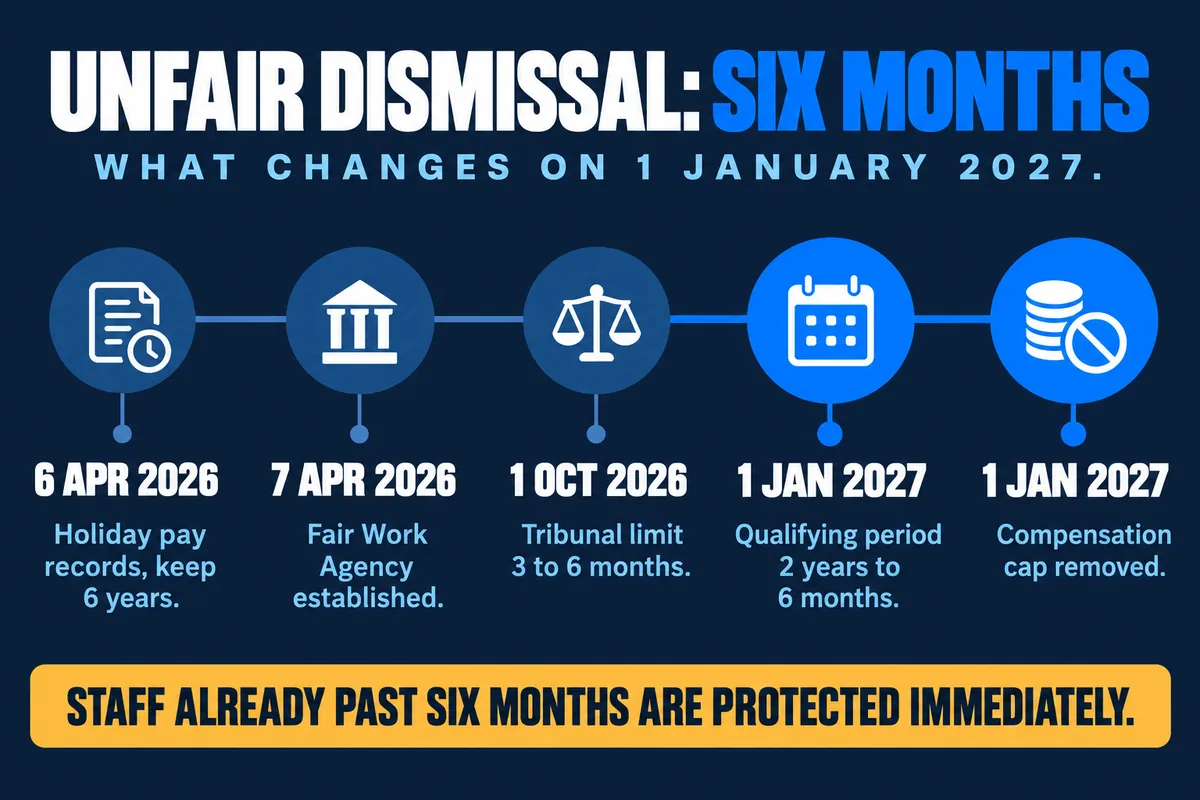
| Date | Change | Status |
|---|---|---|
| 6 Apr 2026 | Duty to keep annual leave and holiday pay records for at least six years | In force |
| 7 Apr 2026 | Fair Work Agency established | In force |
| 1 Oct 2026 | Tribunal claim time limit rises from three months to six | In force |
| 1 Jan 2027 | Unfair dismissal qualifying period falls from two years to six months | Coming |
| 1 Jan 2027 | Cap on unfair dismissal compensation removed | Coming |
The government's own overview factsheet puts it plainly: the qualifying period drops from two years to six months, and "the current cap on compensatory awards will also be removed".
Why the cap matters more than the qualifying period
Most commentary leads on the six months. The removal of the cap is the larger change.
A statutory limit made exposure broadly predictable, and it is why some employers have treated a weak paper trail as a commercial risk worth carrying. With compensation based on actual financial loss, a claim from a long-serving, well-paid employee can be worth considerably more than the same claim today.
That moves documentation from an administrative question to a financial one. The paperwork is no longer about tidiness; it is the thing that determines whether an uncapped claim succeeds.
The trap: existing employees are protected immediately
This is the detail that catches people out. The six-month protection does not start counting on 1 January 2027. Everyone who already has six months service on that date is protected from day one, and everyone else gains it as they reach six months.
In practice, anyone hired from roughly the end of June 2026 onwards will be covered in January. So the records that matter are already being created now, in probation reviews happening this month, for people who are not yet protected but will be.
Claims now arrive much later
The tribunal time limit rose from three months to six on 1 October 2026. That sounds procedural, and for record-keeping it is significant.
A dismissal in January can now surface as a claim in July. By then the manager who held the probation meeting may have left, the informal note may have been in a mailbox that was deleted when they did, and the shared drive may have been reorganised twice. The question is no longer only whether you did the right thing, but whether the evidence survived six months of ordinary organisational churn.
What a tribunal actually wants to see
Evidence that a fair reason existed and a fair procedure was followed, with dates attached:
- The contract, any variations, and the job description
- Probation reviews and performance appraisals, dated
- Objectives set, support and training offered, and whether it was delivered
- Notes of informal conversations, which are often the only contemporaneous record of early concerns
- Invitation letters to formal meetings, and evidence of the right to be accompanied
- Minutes of those meetings
- The outcome letter and the reasons given
- The appeal, who heard it, and its outcome
The common failure is not an absent process. It is being unable to show the process happened when it is said to have happened. A performance note that could have been typed the week after the dismissal is weak evidence, however accurate it is.
Keeping them long enough
Retention is now the other half of the problem, because the window to defend has doubled.
Annual leave and holiday pay records carry a statutory six-year retention from 6 April 2026, which we covered in detail in the six-year rule for holiday pay records. For dismissal evidence there is no single prescribed period, so the practical floor is the limitation period for claims that could follow, and six years is where most employers land to align with contractual claims.
The balance has shifted. Disposing too early is now the bigger risk, which is the opposite of the instinct most data protection training installs. Our guide to how long to keep business records in the UK sets out the schedule across categories.
Where a shared drive stops being adequate
Most HR files live on a shared drive or in a folder on someone's laptop. That is fine until the date a document was written is contested.
A shared drive cannot reliably show when something was created, whether it was changed afterwards, or who opened it. A file's modified date changes if someone merely opens and saves it. That is precisely the question in dispute when one side says a note was contemporaneous and the other says it was written after the decision.
What removes the argument is a record that is timestamped on creation, versioned so earlier drafts remain visible, and access-logged so you can show who saw what and when. DocFlow holds HR files that way, with retention applied per category automatically and an audit trail that cannot be rewritten after the fact.
DocFlow is built and supported in the UK by Mastercopy, which holds ISO 27001 for information security and ISO 9001 for quality management, and has served organisations in regulated environments since 1989.
Sources: the commencement dates, the six-month qualifying period, the removal of the compensation cap, the 6 April 2026 holiday records duty, the Fair Work Agency and the 1 October 2026 tribunal time limit are all taken from Acas guidance on the Employment Rights Act 2025 and the government's Employment Rights Act 2025 factsheets. The Act itself is on legislation.gov.uk. This is general information about record keeping, not legal advice. Last reviewed 23 October 2026.